


Badarpur: The Best 9:00 to 5:00 I Could Ever Ask For (Field Visit, Part II)

-----------------------------------------------
A note from the author (that's me, hi!) before we begin:
If you're coming here after reading my part one, great! Thank you for making it through the fifteen-hundred-word stream of consciousness that was supposed to eventually become this very story.
If you're coming here without having read the prior post, not to worry! It is most certainly not a prerequisite, though there is a bit of catching up for you to do. Allow me to summarize my entire last post:
My supervisor (Aparna) and I, along with two other interns (Maya and Hataishi), drove from Gurugram to the village of Badarpur, located in a much more rural part of our same state of Haryana.
That's it, that's all, and so, without further ado, I present to you, the rest of my story.
-----------------------------------------------
As we all exited the vehicle, the warm Indian air enveloped us. Though it was cooler today, thanks to the grey skies and a blanketed sun, it was still in the upper 90s Fahrenheit. I gathered my things: a small notebook, a pen from the World Food Prize, and my Lifestraw water bottle, then gently closed my door.
I was in awe. The first immediate sight I had seen, and the only picture I took on my own camera while in this village, was of the pool. There were children splashing around, as well as cattle and goats being washed. I had never seen anything like it. As I got out of the car and absorbed my new surroundings, this image set the tone for me in a way I can't fully describe. I felt at peace, comfortable, and that I had finally made it to an area of the world that I had only ever dreamed of working in prior. I was at home here.

We were met by a Sehgal Foundation field officer, a teacher who had been working with the Foundation since its inception in 1999. Following her lead, we were then led to a classroom area in a nearby building. Mothers and young children, from what looked to be, respectively, ages 20 to 50 and 1 to 10, gathered in the yard out front. Our small Sehgal Foundation delegation all kicked off our shoes outside the classroom door, and upon entering, began to prepare the space for today's activities.
The room was plastered with posters from government, health, and philanthropic initiatives, so we found a nail to hang our large flipchart from with relative ease. Aparna and I discussed the questions we had developed, and we each got to work further preparing our materials.
The aim of today's visit was to develop a baseline understanding of this community's needs, their dietary habits, and the best ways to approach providing them with useful information about vitamin A and overall eye health. For the caregivers in particular, it was important to understand where they most often procured food for their families, how seasonal changes affected food availability, and what a typical day's set of meals looked like, among other things, such as whether or not their children had ever exhibited signs of vitamin A deficiency like night blindness or skin issues around the eye.
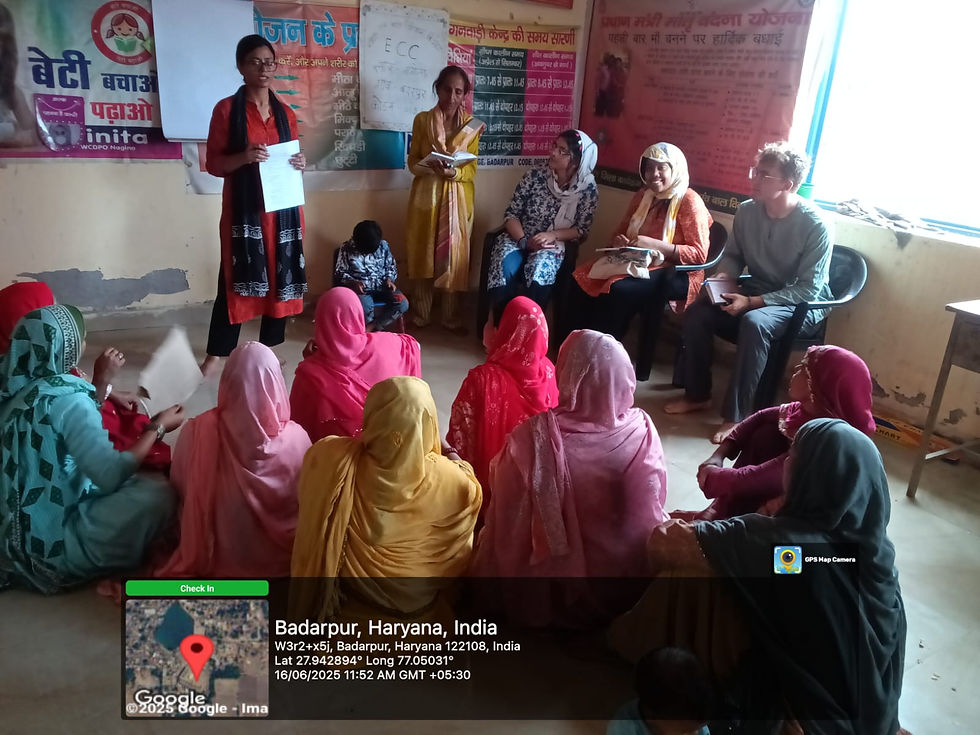
As the mothers came into the room and took a seat, our baseline questioning began. We started, of course, with an introduction, and then moved on to questions specifically pertaining to vitamin A. With answers recorded, we then turned to the flipchart, asking mothers what foods they had eaten for breakfast, lunch, and dinner most recently. I helped to divide the flipchart, but because of my minimal experience with Hindi (I can read and write it, though I don't have a solid grasp on the language and vocabulary itself---an issue I've aimed to surmount by the end of my stay here), I stepped aside so that Aparna could more accurately and efficiently record the mothers' answers.
Now that I was no longer standing at the front of the room, I decided to take some notes of my own. I jotted down my quick thoughts about how colorful the clothes were, about the goats that were just outside the window, about the kids that sat with their mothers or played together in the yard, about the pieces of cardboard that were passed around as fans to ward off the settling heat and still air.
We continued along, prompting discussion and making our way through each of the planned questions. As our final activity, we split the mothers into smaller groups and had each one write down their children's favorite foods and snacks on a piece of poster paper. Following this, we finished our session with a whole group discussion over what each subgroup had written down, ultimately rounding out the morning and our time with the mothers.
Left: Mothers writing answers to our prompts - Right: Aparna and I introducing ourselves and the day's goals
Following this, we moved to a separate space, driving around the pool to get to the other side of the village. We hopped out once more and, greeted by a group of youngsters, walked along the path between buildings to our next session. We were in an open-air porch of sorts with a concrete floor, adjoined to a building which had electricity, unlike the one we were just in. That meant there was an electric fan blowing at the back of the room, which worked wonders in circulating the air and keeping the space from feeling hot and stuffy.
A mat was rolled out for the children to sit on, and Aparna and I, as well as the others from the Foundation, worked to set up this space as well. There were 30 or so children that had shown up, boys and girls, most of whom were between 6 and 12 in age. They were an incredibly well-behaved bunch who, after hearing Aparna explain directions in Hindi, took a seat and made room for all their friends.
This is where my day began to turn unforgettable, as minuscule event after event transpired and stuck like velcro to my heart. It had already been a memorable morning, what with a journey worth an essay over, sights like I had never seen, and an entire session based around questions I had helped to develop, and yet, working with these children struck a new key.

We began by introducing ourselves once more, and unlike the earlier time, when I had been introduced by someone else, I took it upon myself to utilize what little Hindi I could command, and at least say my name.
"मेरा नाम इसहाक है"
"Mera naam Isaac hai"
It's a simple phrase, and really the smallest of things to memorize, and yet, it lit up many of the children's faces to see me at least attempt an introduction in Hindi. I followed up by answering the question of "what is your favorite food?" which we had tagged on to everyone's introductions. My response of "पानी पूरी" "pani puri" made those smiles even wider.
To preface, the night before, I had been out at the market with some of my other intern friends, and we had eaten pani puri. It's a type of bite-sized and deep-fried hollow bread, which is usually stuffed with potatoes and spices and oily goodness. It, along with many of its similarly delectable Indian street food companions, is far from healthy---a fact that would soon come to bite me in the butt.
With the facilitators' introductions complete, we turned next to the children. Each kid took turns standing up, stating their name, age, and favorite food, and sitting back down as their nearby peers soon started this process over again. In my first, and only, act of skewing the day's data, it turned out that pani puri became far and away the most common answer to our question of "what is your favorite food?"

Our first real activity with the kids was similar to the last we had done with the mothers. We split the children into three groups, each of which came up with one food for breakfast, lunch, and dinner from every member. They thought carefully about which foods they would most commonly eat, and made sure that no two group members' answers overlapped. Each group chose three of their members to present at the front of the room, and it was so much fun to see these kids so engaged in an activity that I knew would come around to directly benefit them.
By learning about the diets and eating habits of this community, our aim is to find the places where vitamin A-rich foods can best be incorporated into said diets, staving off this all-too-common micronutrient deficiency. Anywhere from 250,000 to 500,000 children go blind every year due to vitamin A deficiency, or VAD, and thanks to these shocking statistics, it is no surprise that VAD is the leading cause of preventable blindness in children worldwide. Again, to see these kids so happy, active, and interested in the activities I helped to plan meant, and still means, the world to me.
After each group had presented, Aparna and I put together a quick eye health survey of sorts, creating a makeshift "letters on the wall at the optometrist's office" type of activity on a piece of flipchart paper. We wrote two lines of letters from the English alphabet (all of these children had learned these letters in school), and made sure that each individual letter started out large and grew smaller as the line progressed.

Each of the kids passed with flying colors, and rather enjoyed the challenge of calling out the letters as we randomly selected them from the lines. If you can't tell by the ear-to-ear smile on my face in all of these photos, I, too, was having a blast. We talked next about the importance of eye health, and got a gauge on what these kids' favorite snacks were by starting a group discussion. While getting answers to our baseline questions was critical, it was also important to simply create a bond with these children and this community at large. In a fitting tribute to this last point, we finished our session with a game of four corners.
Four corners must not be a popular, or even existent, game in India, as it took a whole lot of explaining before the rules were clear to the entire group. Nonetheless, with a language barrier overcome through translation, the game eventually got off to a start. The children's teacher, sitting down in the middle, would call out "एक, दो, तीन, चार" "ek, do, teen, chaar," that is, one, two, three, or four, and each of the kids in the stated corner would go to the middle and sit, as they were now out.
I lasted a whole two rounds (I went from corner one to two, and two to four) before I was called out in corner four. The kids all laughed and smiled as I sat down with them in the center, surprised that I had gotten out so early. As the rounds played on, the kids grew more and more invested, and ultimately, a winner was crowned. Following this, we regrouped and recapped everything we had gone over during the session. The children shared again what they had learned, and said they were excited for our next visit.
Photos taken during the children's session
Though the official session had ended, and the majority of kids had said goodbye and gone back to their homes, there were a select number that stuck around. We all sat down in a group, and we exchanged questions back and forth. I asked some questions pertinent to my research and my project, like what their favorite activities were, what they enjoyed the most today, and if they had ever had troubles with their eyes, but I soon found myself asking what their favorite animals were, and recording their answers just for fun.
In following this conversation, I had mentioned my many pets back in Iowa, after which I was asked to list them all. I broke it down species by species, and the kids would read out the names of my pets as I wrote them. Despite the fact that they could read my language and I could read theirs, neither of us could speak the other's very well. Laughter dismantled the language barrier brick by brick, and soon enough, we were all smiling and laughing at every little action.

The laid-back afternoon passed like the so-called "rubber time" here in South (and Southeast) Asia is known to, with all sorts of activities and conversation flowing slowly from one to another. Thanks to Hataishi, who was fluent in Hindi, we were able to communicate rather well once she came around. The village girls brought over some henna, which is called "मेंहदी" "menhadee" here, and they drew beautiful temporary tattoos on each of us interns' hands. The boys gathered around me, and we swapped stories and more questions together. Everyone excitedly signed my notebook, and after the afternoon had stretched by, it was time to leave.
Some photos from the afternoon
As we got up to leave, one of my new friends asked, "Do you eat?" I said yes, and he told me to wait. He ran to his house, which was just down the alley, and came back with a plastic-packaged Indian snack. He told me to keep it and enjoy, and so I brought it along with my water bottle and notebook.
At this point, we had picked up all of the posters, markers, and materials and were making our way to the car. One of my other friends dug through his pockets, found a one-rupee coin, and gave it to me, saying it was lucky. I tried to refuse, but he was insistent. He placed the coin in my hand with all of my other belongings.
As we made our way to the car, parked a good fifty feet down the road, I kept finding myself turning around to wave goodbye. The children had all gathered outside the street entrance of the building we had just been in, and each time I turned around to wave, they returned the gesture 10-fold. I was sad to leave, especially after we had just made such a solid and wholehearted connection.
As I climbed into the car once more, these thoughts weighed on me. I looked down at my hands, one tattooed with my name and hearts, the other full of small gifts and a notebook keeping record of all the day's fun memories. It was a bittersweet end to one of the most fulfilling days of my life, and right as my mind began to drift toward reflection, there was a knock at my window.
One of the other boys was standing there, reaching up to the windowsill with something in his hand. I rolled down my window, smiled, and said hi, and he gave the small item to me. It was a glass vial of hand perfume he had shared with his friends and me during the afternoon, and he asked me to please take it. The sentimental value of all these little gifts nearly overwhelmed me in that moment, but I managed to hold it together as I told my friend "धन्यवाद" "dhanyavaad" to express my heartfelt gratitude and thanks.
I waved once more as we drove away, keenly aware of my already growing desire to return. I rolled up my window, took a look at everything in my lap, and allowed myself to savor that moment.

In part one of this blog, I stated that:
"Whenever I am in a country unfamiliar to me, or even one that I've come to know for months on end, I never sleep while in transit. I make it a point to stay awake, to watch the road signs and the scenery, and to see how the landscape and development change as you drive (or ride, in the case of trains) along this foreign land."
I broke that rule on the way back to Gurugram and slept for nearly the whole hour-long drive. I'm sure glad I did, because I don't know that my heart would have been able to handle leaving Badarpur and my new friends there any other way.


Comments